





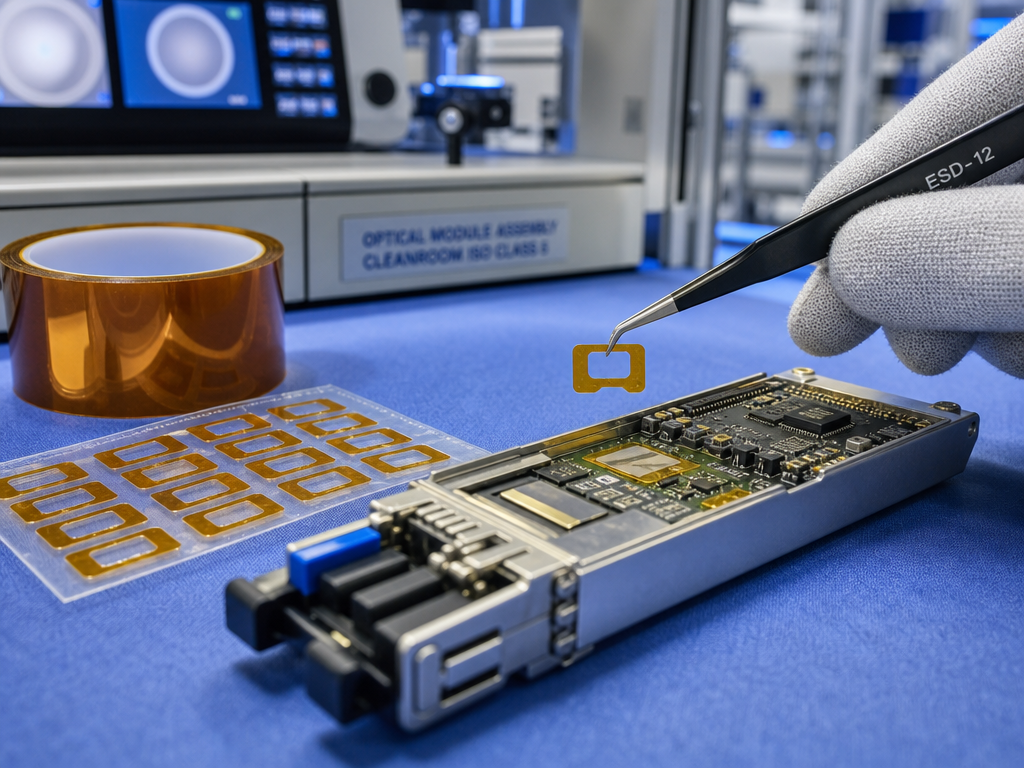
Optical module demand is running hot. Goldman Sachs now puts the global optical transceiver market at roughly $67.7 billion in 2026, with 800G-and-above shipments reaching 78.22 million units, up 166% year on year. TrendForce estimates the AI-specific optical transceiver segment alone will grow from $16.5 billion in 2025 to $26 billion in 2026, a gain of more than 57%.
That growth is pushing module makers into a difficult corner. Higher speeds mean tighter optical alignment tolerances, denser PCBA layouts, more reflow passes, and far less room for process contamination. One of the cheapest variables on the line, the masking tape used to hold, protect and shield components through high-temperature steps, has quietly become one of the most expensive sources of yield loss.
This article explains what silicone-free high-temperature tape actually is, why silicone adhesives cause problems in optical module assembly, where the tape is used on the line, and how to specify it correctly.
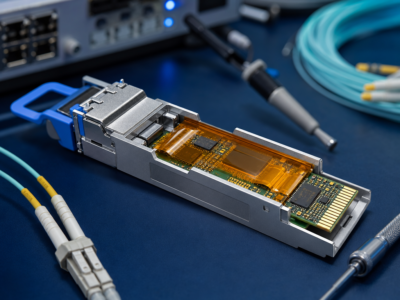
What “silicone-free” actually means
A standard high-temperature polyimide (PI) tape uses a silicone pressure-sensitive adhesive (PSA). It handles heat well and is inexpensive, which is why it became the default for wave solder and reflow masking decades ago.
A silicone-free (non-silicone) high-temperature tape keeps the polyimide film backing but replaces the adhesive with a specially formulated acrylic PSA. The construction looks like this:
| Layer | Silicone PI tape | Silicone-free PI tape |
|---|---|---|
| Backing | Polyimide film (typically 0.025 mm) | Polyimide film (typically 0.025 mm) |
| Adhesive | Silicone PSA | Acrylic PSA (silicone-free formulation) |
| Typical total thickness | 0.055–0.06 mm | 0.042 mm |
| Short-term temperature | 260–290 °C | 260 °C (10 min) |
| Residue after heating | Possible silicone transfer | Clean removal, no adhesive residue |
| Risk to downstream bonding/coating | Siloxane contamination | Negligible |
The difference is not temperature performance. Both survive a lead-free reflow profile. The difference is what the adhesive leaves behind.
Why silicone is a problem inside an optical module
Silicone adhesives contain low-molecular-weight siloxanes, typically cyclic species in the D3–D10 range. These molecules are mobile. Under heat they volatilize, migrate across the assembly, and re-deposit on cool surfaces as a thin, invisible film a few nanometers thick.
In a general electronics build, that film is a nuisance. In an optical module, it lands directly in the optical path. Four failure modes show up repeatedly:
1. Optical surface contamination
Siloxane deposits on lens surfaces, fiber end-faces and isolator windows. Even a monolayer changes the local refractive environment, raising insertion loss and back-reflection. Because the contamination happens after coupling and alignment, it often surfaces as a marginal module that passes initial test and drifts out of spec during burn-in.
2. Adhesion failure in downstream bonding
Silicone is a release agent. Once it has transferred to a pad, housing or fiber ferrule, subsequent epoxy, underfill or conformal coating will not wet the surface properly. Delamination, voids and weak bonds follow.
3. Wire bond and die attach defects
On TOSA/ROSA subassemblies, siloxane on a bond pad reduces wire pull strength and raises the rate of non-stick-on-pad (NSOP) events. This is the same reason semiconductor packaging lines moved to non-silicone tape years ago.
4. Electrical contact resistance
Silicone residue on connector contacts and gold fingers insulates the interface. Under thermal cycling the film can also carbonize, raising contact resistance permanently.
The frustrating part is that none of this is visible. A module can pass visual inspection and electrical test, then fail at the customer site weeks later.
Where silicone-free tape is used on an optical module line
Non-silicone PI tape is a process material, not a component. It goes on, survives a hot step, and comes off clean. Typical stations:
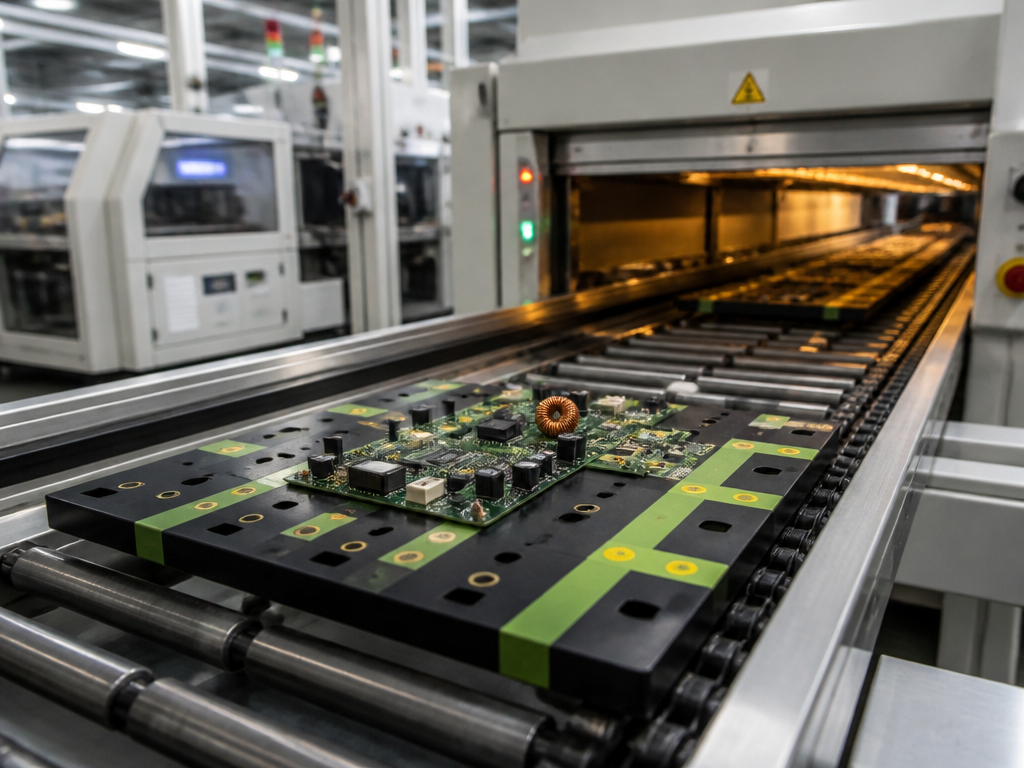
Reflow and wave solder masking on PCBA
Shielding gold fingers, connector lands, sensor windows and areas reserved for later bonding. The tape must hold flat at 260 °C peak without lifting at the edges, then peel without leaving adhesive on the pads.
TOSA / ROSA subassembly high-temperature hold
Holding small ceramic substrates, TO-CAN headers and lens holders during die attach, epoxy cure and wire bonding. Because the tape is removed before hermetic sealing, any residue stays trapped inside the package permanently.
Resin bleed prevention
In MEMS, sensor and semiconductor-style packaging steps used inside modern coherent modules, tape dams stop encapsulant from flowing onto leads and sealing surfaces.
Carrier and transfer of thin, fragile parts
Ultra-thin substrates, flex circuits and spacer films are mounted on tape for handling between stations. The tape needs enough tensile strength and elongation to survive placement without tearing, then release cleanly.
Fiber array (FA) and lens alignment temporary fixation
Holding fiber arrays or micro-optics in position while adhesive cures. Dimensional stability matters more than adhesion here, because a tape that stretches under heat moves the alignment.
Burn-in, aging and conformal coating masking
Protecting contact areas during high-temperature aging and coating, where silicone transfer would directly contaminate the mating interface.
The same material also serves adjacent applications on the same equipment: LiDAR modules, automotive electronics control units, MEMS packaging, lead frame protection and semiconductor packaging. Useful if you run a mixed production floor and want to consolidate to one qualified tape.
How to specify the right tape: seven checks
Getting this wrong usually means either residue (adhesion too aggressive for the temperature) or lift-off (adhesion too low). Run through these before you qualify a part number:
- Match the real thermal profile, not the datasheet number. Record peak temperature, dwell time above 200 °C, number of passes, and whether removal happens hot or at room temperature. “260 °C rated” means 260 °C for 10 minutes in most non-silicone PI constructions. It is a short-term masking rating, not a continuous operating temperature.
- Adhesion window. For clean masking on steel and PCB substrates, 1.8–3.5 N/25 mm is a practical range. Below that, edges lift during reflow. Above roughly 5 N/25 mm, residue risk climbs sharply after heat aging.
- Residue behavior after heat. Test by running the actual profile, then removing at the actual removal temperature and inspecting under magnification. Visual cleanliness alone is not enough if a bonding or coating step follows. Include that downstream operation in the trial.
- Dimensional stability. Look for tensile strength above 3.5 kN/m and elongation above 45%. Biaxially stretched PI film holds flatness better than cast film at temperature, which matters for alignment fixtures.
- Chemical and ionic cleanliness. Confirm RoHS and REACH compliance, and ask about halide and ionic content if the tape touches laser diodes or bare die.
- Converting format. Narrow slitting, die-cut shapes and liner-backed parts reduce manual trimming and improve placement repeatability. Specify tolerances against the actual film thickness.
- Batch consistency. Ask how adhesion and thickness are controlled lot to lot. A tape that varies ±30% in peel force will produce intermittent lift-off that is very hard to diagnose on a running line.
IH890PN: a silicone-free PI tape built for optical module assembly
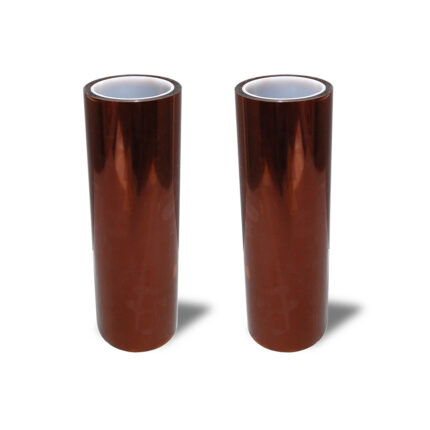
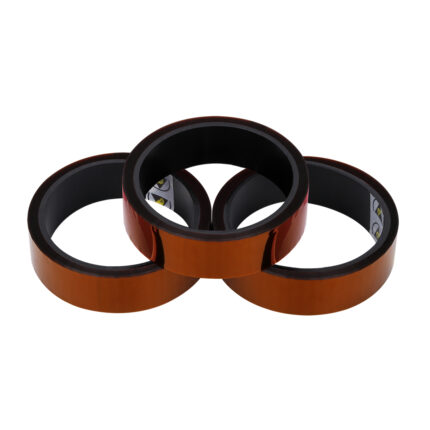
IH890PN is a non-silicone, high-temperature tape based on a polyimide film with a specially formulated acrylic adhesive. It is designed for high-temperature shielding in packaging processes, temporary fixation in high-temperature steps, and as a carrier for ultra-thin parts during transfer.
| Property | Typical value | Test method |
|---|---|---|
| Backing | 0.025 mm PI film | — |
| Total thickness | 0.042 mm | — |
| Adhesion to steel | 1.8–3.5 N/25 mm | GB/T 2792-2014 |
| Tensile strength | > 3.5 kN/m | GB/T 30776-2014 |
| Elongation | > 45% | GB/T 30776-2014 |
| Maximum temperature | 260 °C / 10 min | — |
| Compliance | RoHS | — |
Key characteristics: electrical insulation with clean, residue-free removal; stable adhesion at temperature; good tensile strength and elongation; suitable for surface protection that must be removed after a high-temperature step.
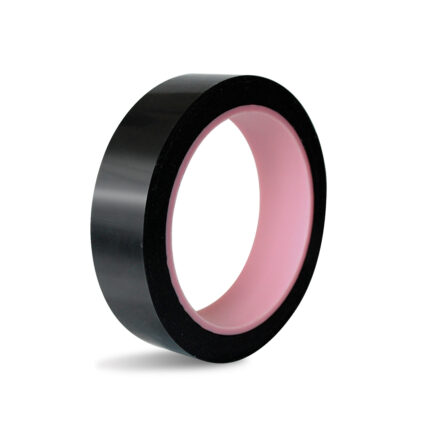
For applications that call for a non-silicone polyimide film tape with a different adhesion balance. Where a silicone adhesive is acceptable and a thicker construction is preferred, the IH803 ESD polyimide tape (0.06 mm, 290 °C) remains an option.
Handling notes
- Apply to a clean, dry surface free of dust, oil and other contaminants.
- Use adequate pressure by roller, hand or press to develop full adhesion.
- Avoid re-sticking; repositioning reduces adhesion.
- Store at 10–30 °C and 40–70% RH, away from direct sunlight.
- Shelf life is 6 months from the date of manufacture in original packaging.
Practical guidance for switching from silicone tape
- Run one station, not the whole line. Pick the step with the highest downstream sensitivity, usually the TOSA/ROSA hold before wire bonding or sealing.
- Include the downstream operation in the trial. Remove the tape, then perform the actual bond, coating or coupling step and measure the result. Silicone transfer problems only appear downstream.
- Remove at a controlled angle and speed. Slow, low-angle peeling reduces the chance of adhesive splitting, especially after heat aging.
- Inspect for more than residue. Check for edge marks, staining, ghosting and any change in surface energy. A dyne pen test on the exposed surface is a quick screen.
- Validate lot to lot. Qualify at least two production lots before locking the spec.
FAQ
Is silicone-free tape as heat resistant as silicone tape?
For masking purposes, yes. Non-silicone PI tapes such as IH890PN are rated to 260 °C for 10 minutes, which covers a standard lead-free reflow profile. Silicone tapes may go higher (up to 290 °C), so if your process actually exceeds 260 °C you should request a dedicated high-temperature grade rather than assuming.
Does “non-silicone” automatically mean low outgassing and low VOC?
No. Silicone-free chemistry removes the siloxane risk but does not by itself guarantee low total outgassing. If you run vacuum processes, specify the test conditions and acceptance limits explicitly.
Does a non-silicone tape provide ESD protection?
Not automatically. Standard non-silicone PI tape is not an antistatic product. If you need static control, ask for a low-static or ESD-rated construction and confirm surface resistance values.
Can it be die-cut into custom shapes?
Yes. Rolls, strips and liner-backed die-cut parts are available. Provide the drawing, dimensional tolerances, liner requirements and delivery format; narrow slitting and small features need to be evaluated against film thickness and adhesive behavior.
How long does the tape last in storage?
Six months from the date of manufacture when stored in original packaging at 10–30 °C and 40–70% RH, out of direct sunlight.
What other industries use this material?
LiDAR modules, automotive electronic control systems, MEMS packaging, semiconductor packaging and lead frame protection, all processes where silicone contamination creates bonding or coating defects.