







“Should we use PI tape or PET tape?” is the most common question we get, and it is usually the wrong question to start with.
Two materials genuinely differ, but the decision is rarely made on the film alone. It is made on three things: the peak temperature and how long the part sits there and how many passes it makes; what the surface has to look like after the tape comes off; and whether anything downstream will bond, coat or plate onto that surface. The film choice follows from those answers.
There is also a distinction that gets lost in most comparisons: the film and the adhesive are independent variables. A PI film can carry a silicone adhesive or a silicone-free acrylic one. A PET film can too. Choosing “PI” does not tell you anything about silicone content, and choosing “PET” does not tell you anything about temperature rating until you know which adhesive is on it.
The short answer
| Polyimide (PI) | Polyester (PET) | |
|---|---|---|
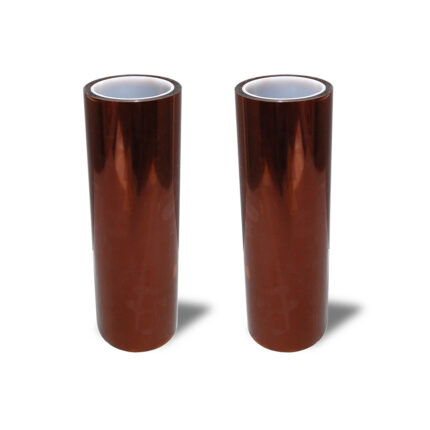
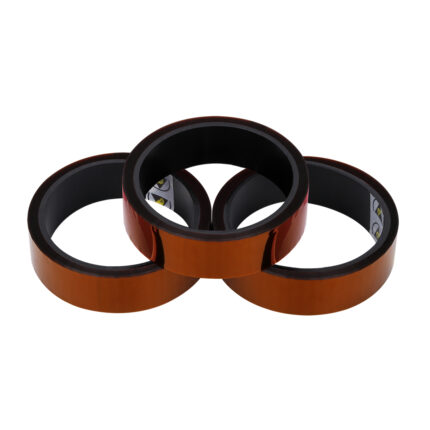
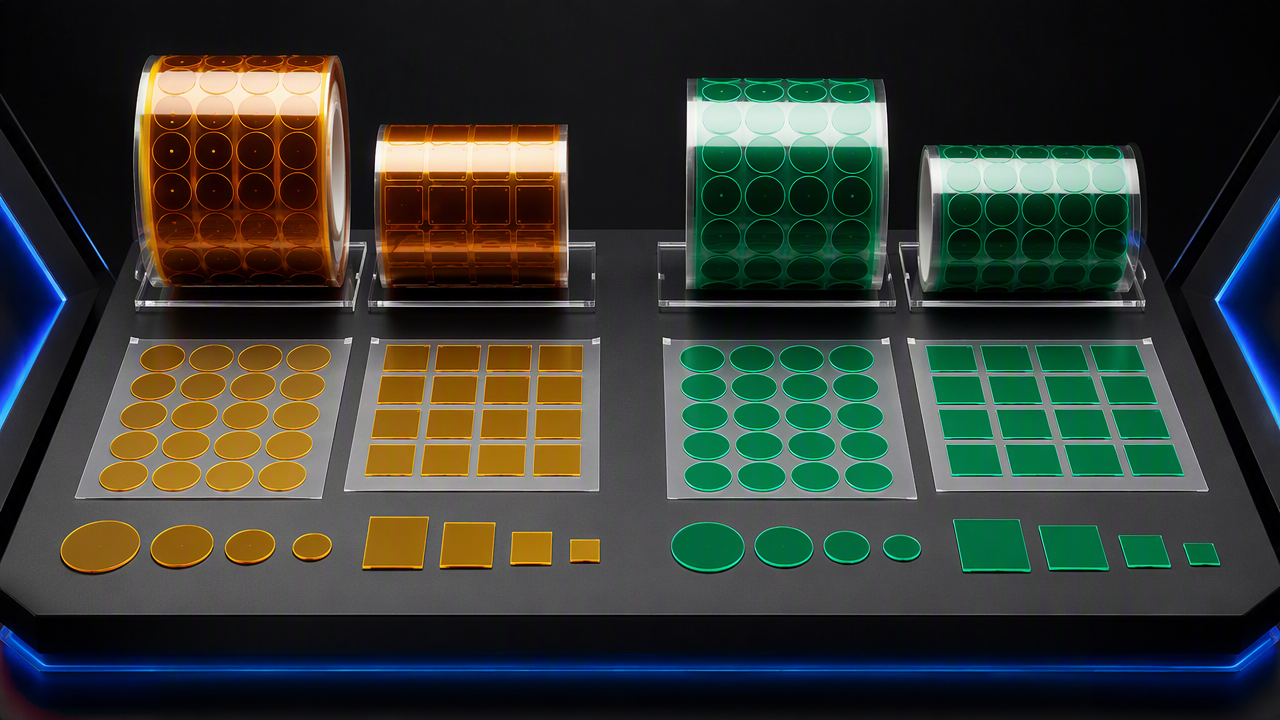
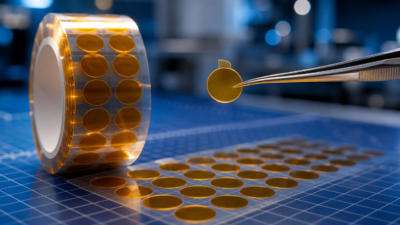
| Typical colour | Amber / amber-brown | Green, transparent, light green |
| Glass transition (Tg) | ~400 °C | ~70–80 °C |
| Continuous use temperature | ~240 °C | ~105–130 °C |
| Short-term masking rating (tape form) | 260–290 °C | 200 °C (typically rated for ~20 min) |
| Tensile strength | ~231 MPa | ~172–220 MPa |
| Elongation at break | ~72% | ≥90% (typical tape grades) |
| Coefficient of thermal expansion | ~20 × 10⁻⁶/K | ~20–30 × 10⁻⁶/K |
| Moisture absorption | ~2.8% | ~0.3–0.5% |
| Dielectric constant (1 kHz) | ~3.5 | ~3.2 |
| Flammability | UL94 VTM-0, LOI ~37% | V-2 (unless treated) |
| Low-temperature flexibility | Retains flexibility to −269 °C | Becomes brittle at low temperature |
| Die cutting behaviour | Thin and soft; needs care | Better dimensional stability, easier to convert |
| Relative material cost | Baseline (high) | Roughly 1/5 to 1/10 of PI |
Figures are typical values from published material data for the base films. Tape ratings depend on the adhesive system, not just the film.
The matrix that actually decides: film × adhesive
This is the part most comparisons skip. Four combinations, four different jobs:
| Film | Adhesive | Temperature window | Silicone risk | Where it belongs |
|---|---|---|---|---|
| PET | Silicone | Up to 200 °C, ~20 min | Yes — silicone present | Powder coating, anodising, general high-temp masking, single-pass reflow masking on non-critical surfaces |
| PET | Acrylic | Ambient to ~120 °C | No | Labels, SMT splicing, general-purpose holding, low-temp masking |
| PI | Silicone | 260–290 °C | Yes — silicone present | Lead-free reflow, wave solder, gold finger protection, multi-pass thermal cycles |
| PI | Silicone-free acrylic | ~260 °C (short-term, e.g. 10 min) | No | Any process followed by bonding, coating, plating, or optical assembly |
Two things worth pulling out of that table. First, the highest temperature rating and the lowest contamination risk are not on the same product — silicone PI tape runs hotter than silicone-free PI tape, so “we need both 260 °C and no silicone” is a real engineering conversation, not a given. Second, PET is not automatically the cheap-and-dirty option; PET with a silicone adhesive is the correct, economical answer for a 200 °C powder-coat bake that runs for twenty minutes, and using PI there is simply wasted margin.
Temperature: the number that gets misread
The comparison table shows PI at roughly 240 °C continuous and PET at 105–130 °C continuous. In tape specifications you will see different numbers — typically 260–290 °C for PI and 200 °C for PET — and the gap causes confusion.
Both are correct, because they measure different things:
- Continuous use temperature describes the film in service over a long period.
- Masking rating describes short exposure during a process step. Polyester masking tapes are rated to 200 °C for 20 minutes; PI tapes are rated 260–290 °C depending on construction.
So the practical question is not “does my process reach 200 °C” but “what is the peak, for how long, and how many times“. A single 20-minute bake at 200 °C is a PET job. A lead-free reflow peak of 245–260 °C is not, regardless of how short the peak is, because the PET film is approaching the point where it softens and shrinks — and a shrunken tape lifts at the edge, which is exactly when solder or coating gets underneath.
Why can PET tape survive a wave solder line when PET flexible circuits cannot be soldered? Because the requirements are different. A PET circuit substrate has to hold copper registration through reflow; a masking tape only has to stay put and come off cleanly. Conflating the two is the source of a lot of contradictory advice online.
One more caution: ratings assume the tape is applied to a clean, dry surface and pressed down properly. A tape that is floating over flux residue will fail below its rating, and the failure will be blamed on the material.
Mechanics: PET is easier to work with, PI is tougher
This is the least discussed and most practical difference.
PI film is thin and soft. 25 µm PI backing is common, and at that thickness the film drapes over edges well but is more demanding to die cut — it stretches and needs sharper tooling and tighter tension control.
PET has better dimensional stability through converting. E1-TH863G PET tape is specified for exactly this reason: stable dimensions, easy die cutting, chemical and corrosion resistance. If your part is a die-cut gasket or a shaped mask rather than a strip off a roll, PET is often the easier material to hold to tolerance.
Elongation runs the other way. PET tape grades typically reach 90% elongation at break; PI film is around 72%. For wrapping and conforming over irregular shapes, the extra stretch helps.
Low temperature is PI’s quiet advantage. PI retains flexibility down to cryogenic temperatures; PET becomes brittle. Anything that sees cold-chain, outdoor winter conditions, or a low-temperature test chamber should be checked for this.
Chemistry and environment: one counter-intuitive result
PI absorbs more moisture than PET — roughly 2.8% against 0.3–0.5%. This surprises people who assume the higher-performance material wins every line of the table.
It matters in a specific way: moisture absorbed into the film turns to vapour during a rapid high-temperature excursion. In flexible circuits that shows up as delamination or popcorning, which is why PI-based flex requires baking before assembly. In tape applications the effect is smaller, but the storage guidance still applies — keep material in its original packaging, in the specified temperature and humidity band, and respect the shelf life.
Solvent and chemical resistance favours PI. PI withstands flux, most cleaning solvents and etchants. PET handles most process chemicals at room temperature but is attacked by strong alkalis and hydrolyses in hot water or steam.
UV stability favours PET. PI yellows and degrades under prolonged UV; PET holds up better. For anything that will live in daylight, the film choice and any protective top layer should be considered together.
Flammability favours PI, with UL94 VTM-0 and a limiting oxygen index around 37%.
Electrical: not the differentiator you might think
Dielectric strength is high for both materials — PET grades commonly exceed 150 kV/mm, and PI is in the same class. For insulation at typical tape thicknesses, both are adequate, and the film choice is usually driven by temperature rather than dielectric performance.
The same applies to ESD. Antistatic versions exist on both films. E1-TH862G PET tape measures 10⁶–10⁸ ohms surface resistance with under 100 V static discharge when unwound from the roll; the E1-IH803 PI tape is an antistatic construction as well. Needing ESD protection does not by itself push you to PI — needing ESD at 260 °C does.
Cost: where the money actually goes
PI film costs roughly five to ten times PET film. On a high-volume masking operation that difference is real, and it is why the default answer should not be “use PI everywhere”.
The cost that matters more is the cost of a failure. A powder-coat line using PI where PET would do is overspending on every roll. An SMT line using PET on a lead-free profile is saving a few cents per board and risking edge lift, solder ingress under the mask, and rework. Specify to the process, not to the comfort level.
Selection by process
| Process step | Peak temperature | Film | Note |
|---|---|---|---|
| Powder coating, painting, anodising | 180–200 °C, long bake | PET | PET’s home ground; 200 °C / 20 min rating fits |
| Conformal coating masking | Ambient to moderate | PET or paper | Edge bleed and static matter more than temperature |
| Wave solder masking (mixed board) | 250–260 °C | PI | Also exposed to flux immersion |
| Lead-free reflow, single pass | 245–260 °C | PI | Check number of passes |
| Multi-pass reflow | 245–260 °C × N | PI | Accumulated thermal load, not just peak |
| Gold finger / edge connector protection | 250–290 °C | PI | See gold finger masking: six cases |
| Optical module, sensor, lens assembly | Varies | PI, silicone-free | Silicone contamination is the constraint, not heat |
| Semiconductor, die attach, wire bond | 200–260 °C | PI, silicone-free | NSOP and delamination risk |
| SMT splicing | Ambient | PET | SMS18 series; mechanical load, not thermal |
| Labels and identification | Ambient | PET | Printability and cost |
| Die-cut gaskets and shaped parts | Depends on end use | PET preferred for converting | Better dimensional stability through the die |
Part numbers
Polyimide (PI)
| Part no. | Construction | Notes |
|---|---|---|
| E1-IH803 | PI film, silicone adhesive, antistatic | Reflow and wave solder gold finger protection; high-temperature masking |
| E1-IH807J | PI film, silicone adhesive, antistatic, 0.1 mm | Thicker construction where mechanical protection is needed |
| IH890PN | PI film, silicone-free acrylic, 0.025 mm backing / 0.042 mm total | 260 °C short-term; optical modules, semiconductor, pre-bonding processes |
| IH890S | PI film, silicone-free | Silicone-free alternative in the same family |
| E2-B821B | Antistatic PI film | ACF heat bonding and thermally conductive applications |
| DIH772A-B / DIH775A-B / E2-DIH776A-B | PI double-sided, silicone | 260 °C; 85 µm, 200 µm and 205 µm constructions |
Polyester (PET)
| Part no. | Construction | Key data |
|---|---|---|
| E1-TH862G | PET, silicone adhesive, green | 0.025 mm backing, 0.060 mm total, 5–7 N/25 mm, ≥4 kN/m tensile, ≥90% elongation, 10⁶–10⁸ Ω, <100 V discharge, 200 °C |
| E1-TH862A | PET, silicone adhesive, light green | 45 µm total, 5–7 N/25 mm, 200 °C |
| E1-TH862TD | PET, silicone adhesive, transparent | 60 µm total, 5–7 N/25 mm, 200 °C |
| E1-TH863G | PET, silicone adhesive, green with arrow marking | 200 °C; specified for dimensional stability and easy die cutting; chemical and corrosion resistant |
| SMS18 series | PET, acrylic adhesive | SMT splice tape, 8–88 mm |
All listed products are RoHS compliant. Store at 10–30 °C, 40–70% RH, out of direct sunlight; shelf life is 12 months from manufacture in original packaging.
Five misjudgements we see repeatedly
- “PI is better, so use PI.” PI wins on temperature and chemical resistance. PET wins on cost, converting stability, elongation and UV. On a 200 °C bake, PI is waste.
- “It’s rated 260 °C, so it’s fine at 260 °C continuously.” Ratings are short-term masking values. Continuous-use temperature for the film is a different, lower number.
- “We need ESD, so it has to be PI.” Antistatic constructions exist on PET. Temperature decides, not ESD.
- “PI absorbs less moisture.” It absorbs more — about 2.8% versus 0.3–0.5% for PET. Store both properly.
- “It left residue, so the tape is bad.” Residue usually means the peak temperature exceeded the rating, the surface was contaminated, or the tape was removed hot. Removal after cooling to room temperature is the general rule; check the specific product guidance.
Frequently asked questions
Can PET tape survive reflow?
Not a lead-free profile. PET tape is rated around 200 °C for roughly 20 minutes; a SAC305 peak of 245–260 °C is beyond that. Use PI for reflow and wave solder.
Is silicone-free the same as PI?
No. Silicone content is a property of the adhesive; PI is the film. Silicone-free PI tape exists (IH890PN, IH890S), and so does PET with silicone adhesive. The two axes are independent.
Which one die-cuts better?
PET, generally. It has better dimensional stability through converting, which is why specifies E1-TH863G for die-cut applications. PI can be die cut but needs tighter process control.
Why is PI amber and PET green?
The amber colour is intrinsic to polyimide resin. PET is naturally clear, so it can be supplied transparent or pigmented — green is conventional for high-temperature masking and makes the tape easy to spot on a board. If you need to see through the tape for alignment or inspection, ask for a transparent PET grade.
Does PI tape work at cryogenic temperatures?
Yes. PI retains flexibility down to roughly −269 °C, while PET becomes brittle. Low-temperature applications are a PI case.
How do I know if I need silicone-free?
If anything downstream involves bonding, conformal coating, painting, plating, or an optical surface, yes. Silicone contamination is invisible, survives the process, and surfaces later as delamination or coating defects. See silicone-free high-temperature tape for optical modules for the failure mechanism in detail.